
For World Conservation Day on July 28, we revisit the sunglasses CANOPY co-founder and prolific designer Yves Béhar created from plastic collected from the Great Pacific Garbage Patch.
Somewhere between Hawaii and California, across roughly 1.6 million square kilometers of open water—an area twice the size of Texas—floats the largest accumulation of ocean plastic on the planet. By Dutch nonprofit The Ocean Cleanup’s most recent accounting, the Great Pacific Garbage Patch holds an estimated 100,000 metric tons of debris, some 1.8 trillion pieces, the overwhelming majority of them microplastics too small to see.
In October 2020, The Ocean Cleanup released a stylish consumer product made from the first detritus it recovered from the patch: sunglasses, designed by our cofounder Yves Béhar and his San Francisco studio Fuseproject.
The deep blue, slightly iridescent color of the frames and arms invokes the ocean’s inky depths; a contrasting turquoise flashes at the temples. Because the plastic composite used—mainly recycled fishing nets and HDPE—is slightly softer than standard plastic, the sunglasses’ thicker frame ensures they are as durable as possible while still being comfortable to wear.

“What is called ‘trash’ is actually a valuable material that can be used for complex as well as beautiful applications,” Béhar told designboom. “How could we design something that becomes an instant proof that what we throw away is a precious resource with great potential?”
Eighteen-year-old Dutch aerospace-engineering student Boyan Slat founded The Ocean Cleanup in 2013 to rid the seas of plastic. Its technology, first deployed in 2019, uses large U-shaped barriers that float in the water, passively collecting plastic for later retrieval.
This plastic is challenging to recycle: much of it has been in the water for decades, brittle and degraded, and a jumble of fishing nets, bottles, and crates. The Ocean Cleanup worked with partners to develop a new supply chain to turn the plastic into pellets for use in manufacturing, tracing the new material from water to shore under a new chain-of-custody standard by certification body DNV GL. Every pair of sunglasses has a QR code printed inside the temple to connect each owner to their specific contribution and the plastic pulled from the patch.
To minimize the likelihood that these sunglasses would become waste at the end of their lifecycle, Béhar and fuseproject designed every component, manufactured by Italian eyewear brand Safilo, to snap apart easily for recycling. “Our easily removable hinges are not inserted within the plastic as is common in traditional eyewear, which means the glasses can be repaired or recycled at the end of their use,” he told Dezeen.
Even the accessories closed the loop: the case was cut from the HDPE floater of system 001, the organization’s first trash-fighting system known as “Wilson,” deployed in 2018, and the pouch was made from recycled PET bottles.
Priced at a €/$199 “contribution,” the sunglasses funneled 100 percent of proceeds back into cleanup operations. A single pair, the nonprofit estimated, funded the removal of plastic from an area of the patch equivalent to 24 football fields.
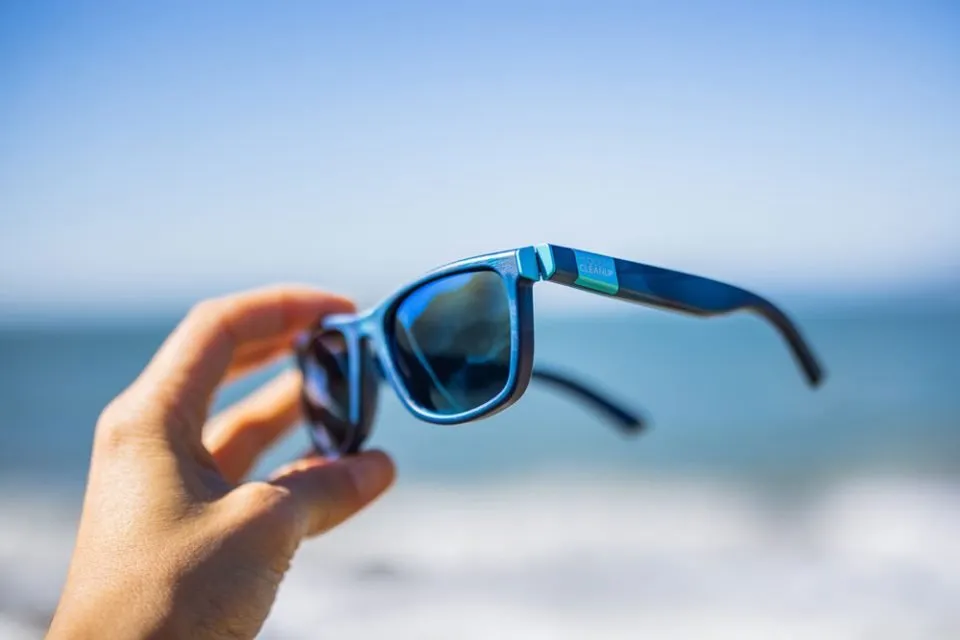
The first batch of sunglasses sold out by early 2022, but the proof of concept still holds. As of early 2026, The Ocean Cleanup reports having removed more than 50 million kilograms of plastic from rivers and oceans, with a stated goal of clearing 90 percent of floating ocean plastic by 2040.
For anyone who cares about how objects are made—and how we choose to work and gather affects the environment—the most persuasive example of sustainability is the kind that is well-designed, desirable on its own terms, and honest about where it came from.
Learn more about Béhar’s sunglasses and the largest cleanup in history at The Ocean Cleanup. Discover CANOPY’s sustainability initiatives and our journey to become carbon positive here.